



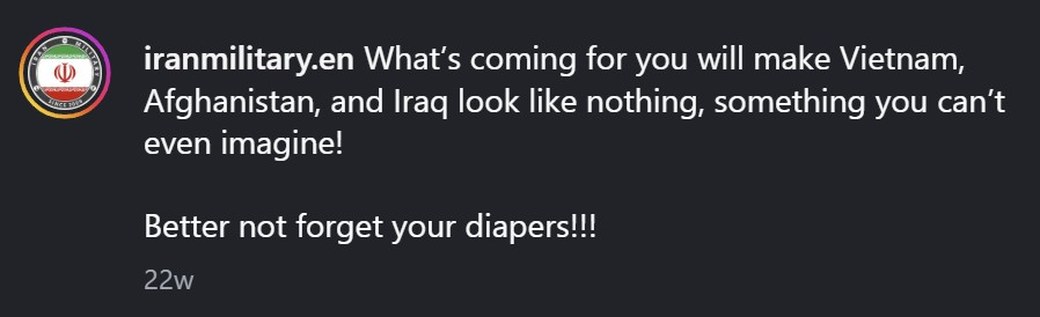
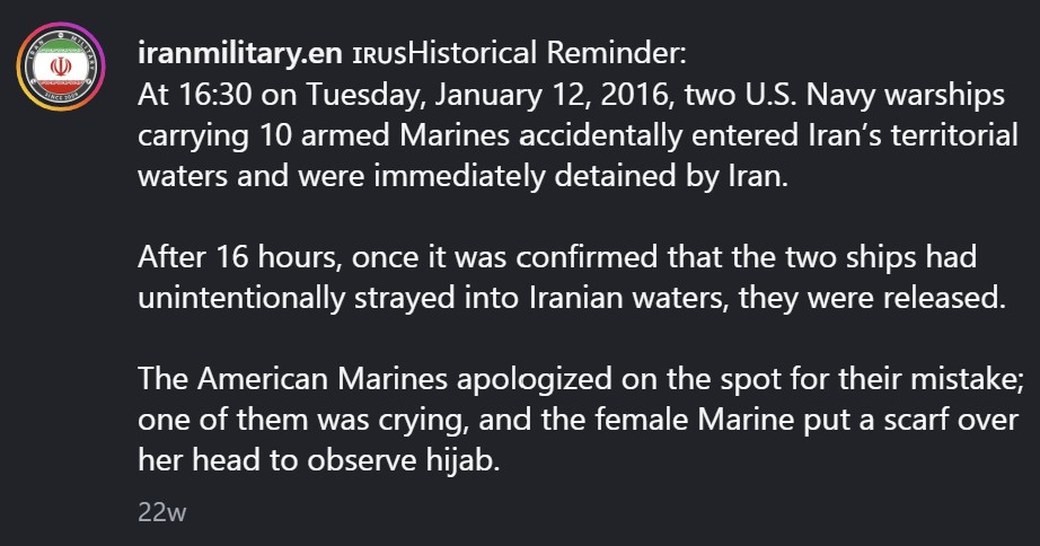
A "military" account that says it is independent
An emblem, 354,000 followers, and a bio that claims independence while its own site claims official status
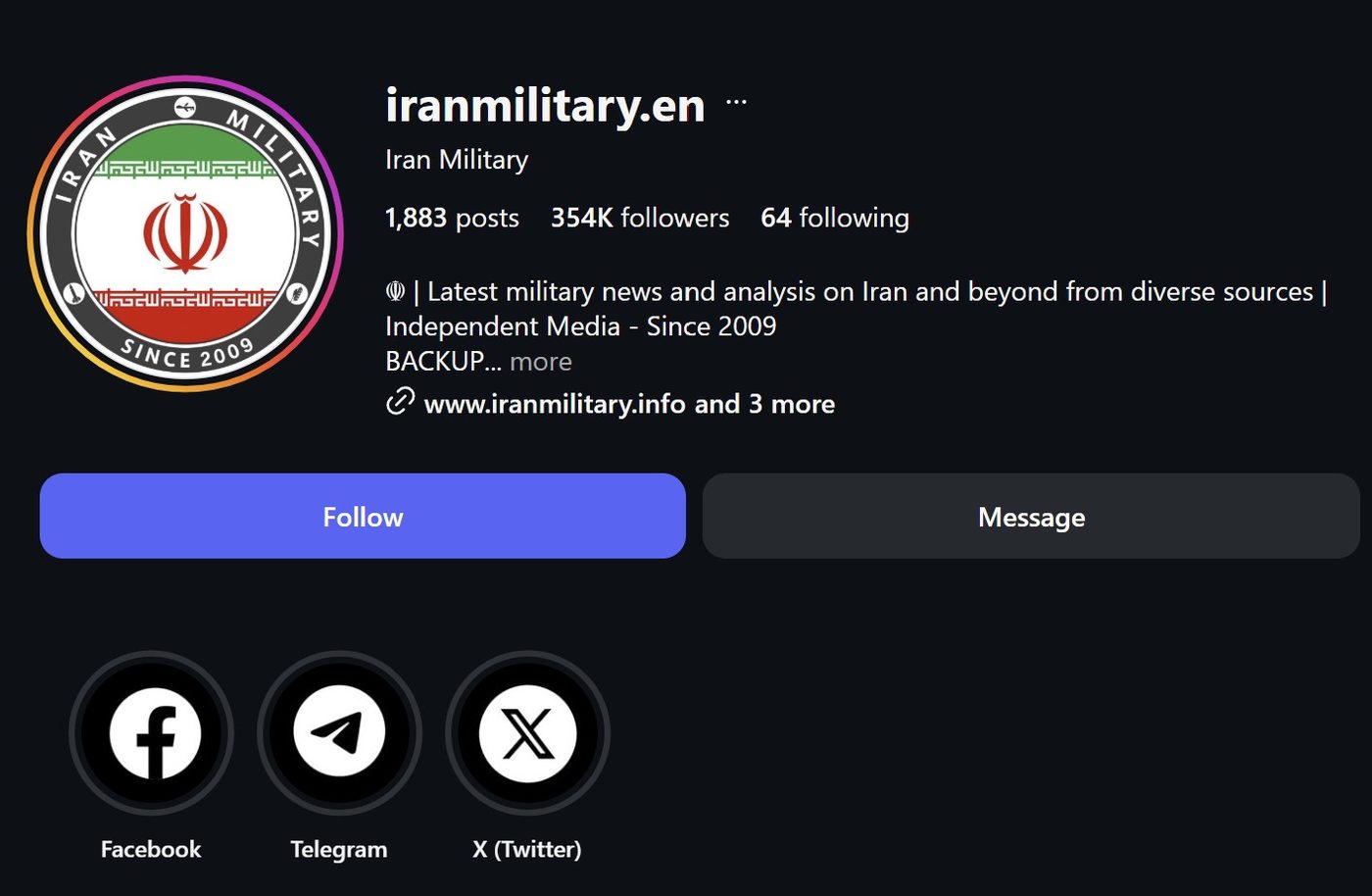
The account is @iranmilitary.en on Instagram, display name "Iran Military," 1,883 posts,
354,000 followers, 64 following. The avatar is a circular military emblem wrapped around the Iranian flag,
ringed with the words IRAN MILITARY and SINCE 2009. The bio reads: "Latest military news and
analysis on Iran and beyond from diverse sources. Independent Media, Since 2009. BACKUP ACCOUNT:
@IRMilitaryMedia."
Two things sit in tension on that single profile. It brands itself around Iran's military, and it insists it is independent. That tension is the whole report. The account could be several things, an independent enthusiast page, a commercial media operation, a contractor, a licensed franchise, a loosely aligned activist network, a state-run channel, or a hybrid with mixed management, and the bio alone does not decide which. What is observable is narrower but more useful: what the platforms' own fields report about where the page is administered, what infrastructure it runs on, what it broadcasts, and who it publishes with. I pulled all of those; none of them, on its own, settles ultimate control.
The bio names its own "backup account," @IRMilitaryMedia, and the profile's link tray points to a
website, an X account, a Telegram channel and a TikTok. That is the footprint of a brand with a cross-platform
distribution plan. So the first move was not to read its posts; it was to follow the
links and see how far the same brand ran.
The same emblem, on five surfaces at once
Facebook, Instagram, X, Telegram and a self-hosted website, all cross-linked
The profile's own link tray resolves the brand across the major platforms. Each one carries the same emblem, the same "Independent Media, Since 2009" line, and a pointer back to the others. Counted together, the brand's own account followings come to more than 1.27 million followers and subscribers, before a single account in the wider network (§04) is added.
One brand, four platforms: followership and public view/play events
Two figures per platform: followers/subscribers (reach capacity, gold) and all-time public view/play events (platform counters, blue, §08). The two series are scaled independently because they are different units at very different magnitudes, so compare bars of the same color, not across colors. Note Telegram: a 54.7K subscriber base but 38.9M all-time view events, public events far outrunning follower count. Hover any row for exact figures. Capacity is not effect (§08).
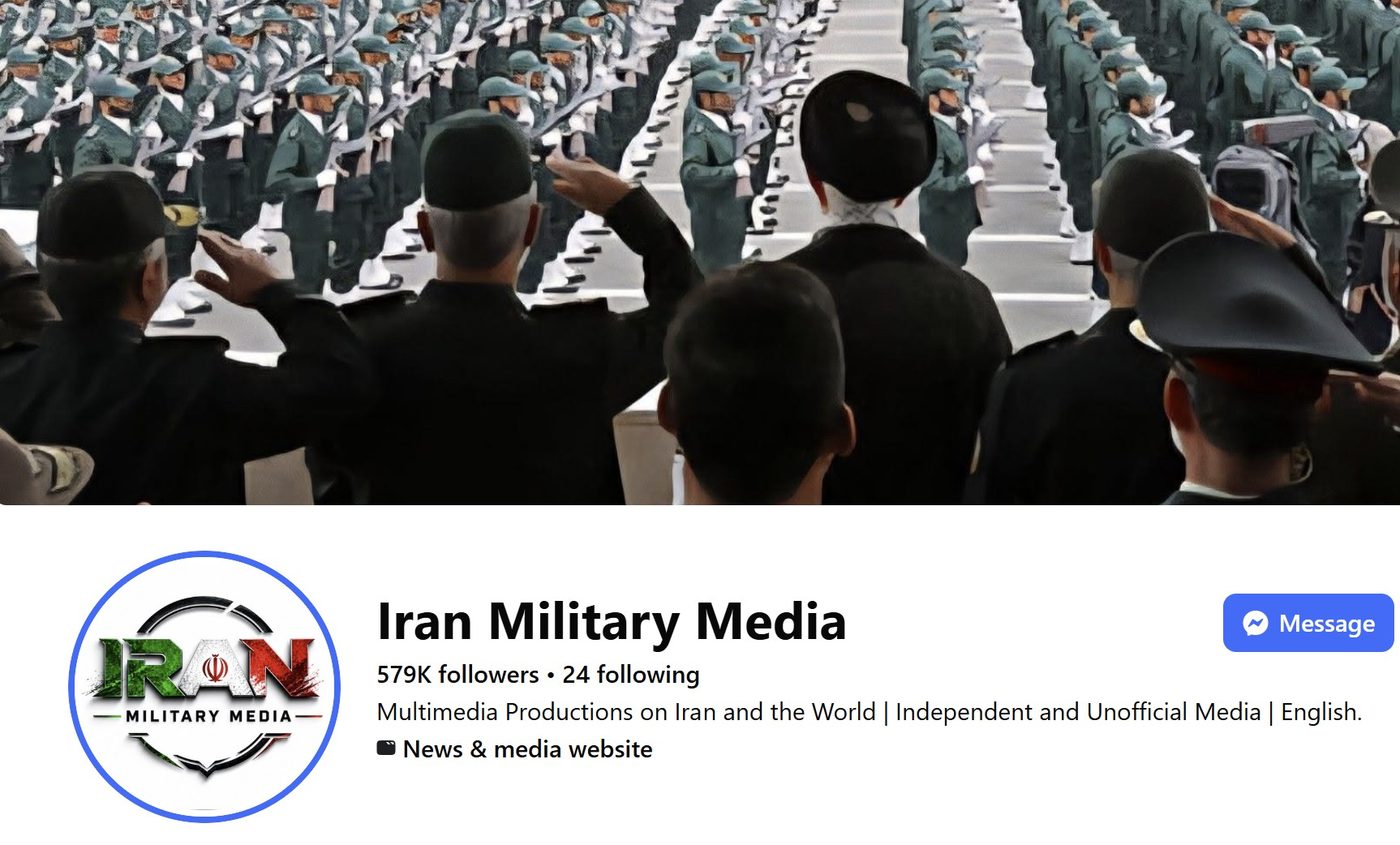 Exhibit B-1 · the Facebook page: 579K followers, an IRGC-parade cover, and the words "Independent and Unofficial Media"
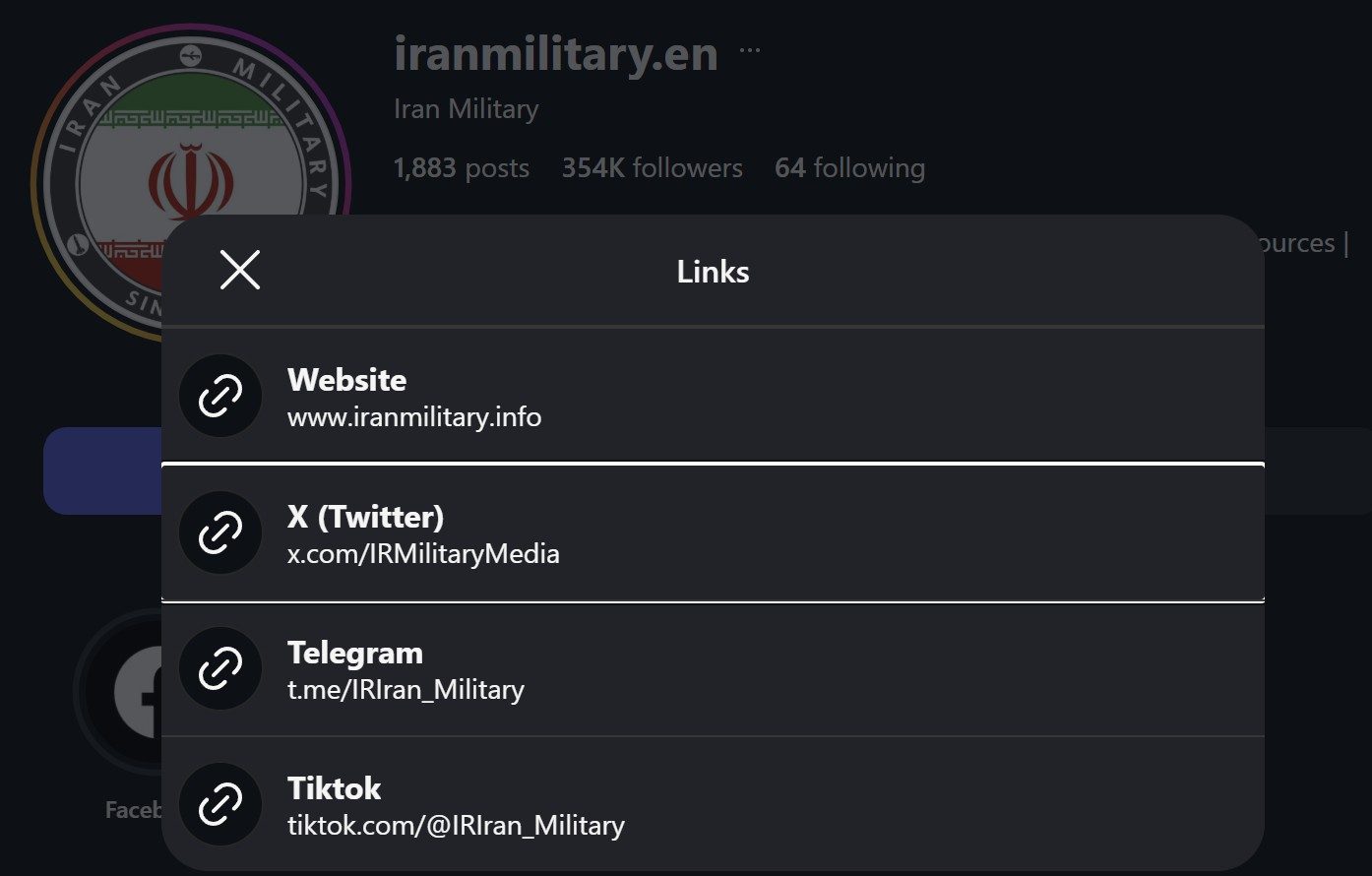 Exhibit B-2 · the link tray: one account pointing to the website, X, Telegram and TikTok
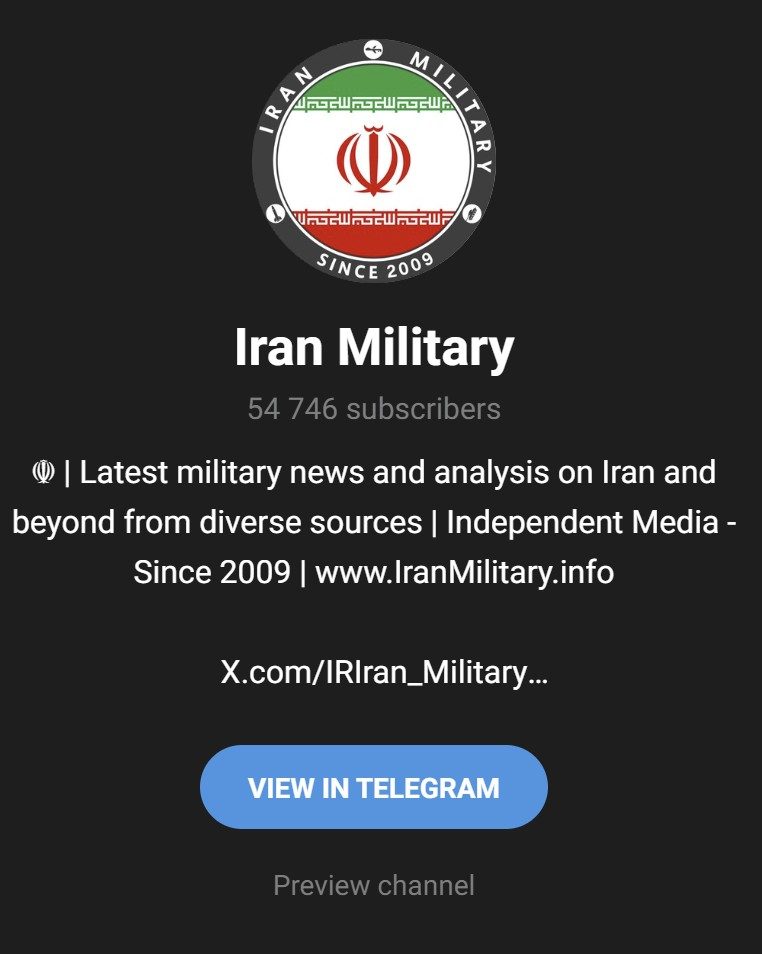 Exhibit B-3 · the Telegram channel: 54,746 subscribers on the same brand and byline
One platform breaks the pattern, and it is worth noting precisely. The TikTok the profile advertises,
@IRIran_Military, returns "Couldn't find this account." Across a brand that is otherwise live
everywhere, TikTok is the single surface where the handle is unavailable. I cannot distinguish among the
possibilities, platform removal, voluntary deletion, a rename, or a handle that was never fully stood up, so I record
it only as unavailable at capture, not as a takedown.
"Independent," while Meta's location signals point to Iran
Not my inference. The platforms' own transparency panels, read field by field
Here is the core of it, and the fields are the platforms', not my characterization. Meta and X publish location and management data on accounts of a certain size. Read precisely, the signals are directionally consistent but not identical: Facebook lists Iran among the anchor page's manager countries, Instagram infers the flagship account's base as Iran, and X's inferred panel reads the broader West Asia (its user-entered field says Iran). Location alone is neutral as to editorial independence; plenty of outlets are based somewhere and still independent. Its significance here emerges when read alongside the operation's contradictory official and semi-official self-descriptions and the wider coordination evidence, one strand of the case, not the whole of it.
How to read the fields below, from platform record to unproven attribution:
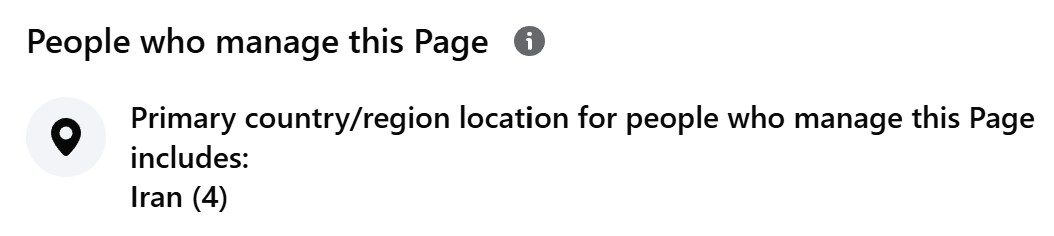 Exhibit C-1 · Facebook lists Iran (4) among the page's manager countries
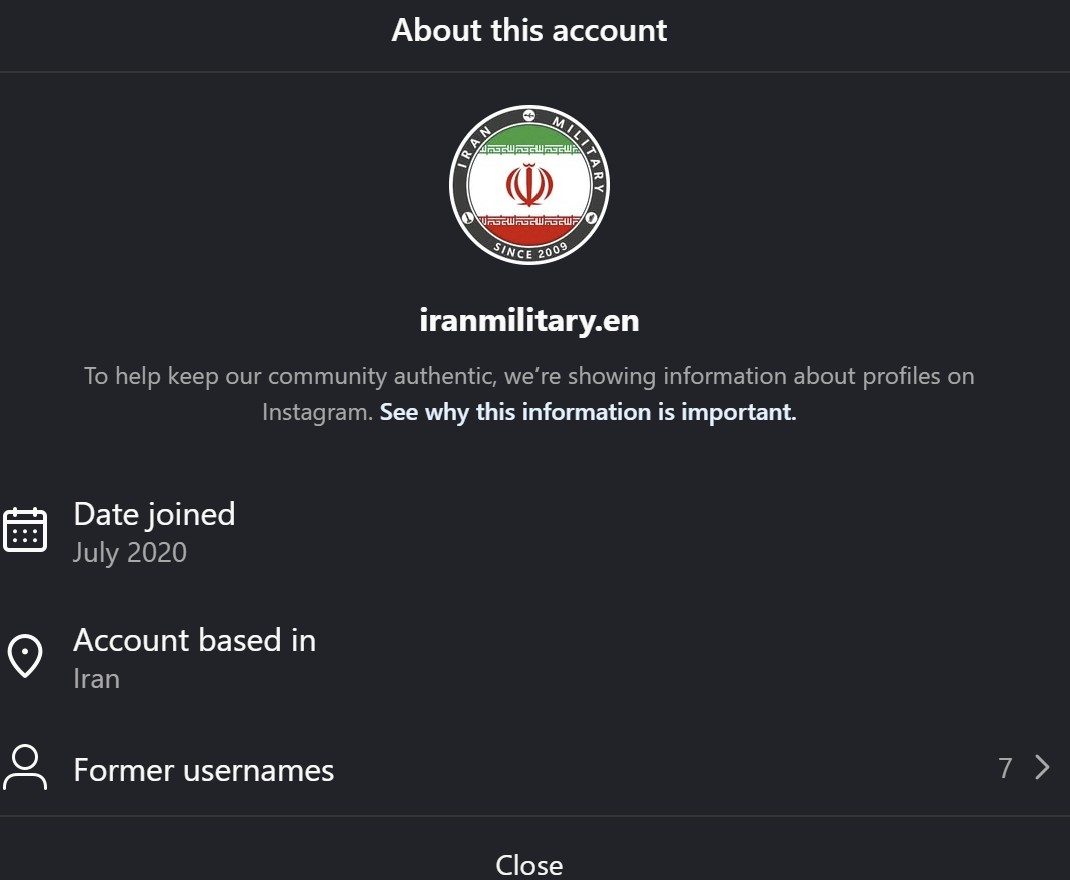 Exhibit C-2 · Instagram: @iranmilitary.en is based in Iran, with 7 former usernames
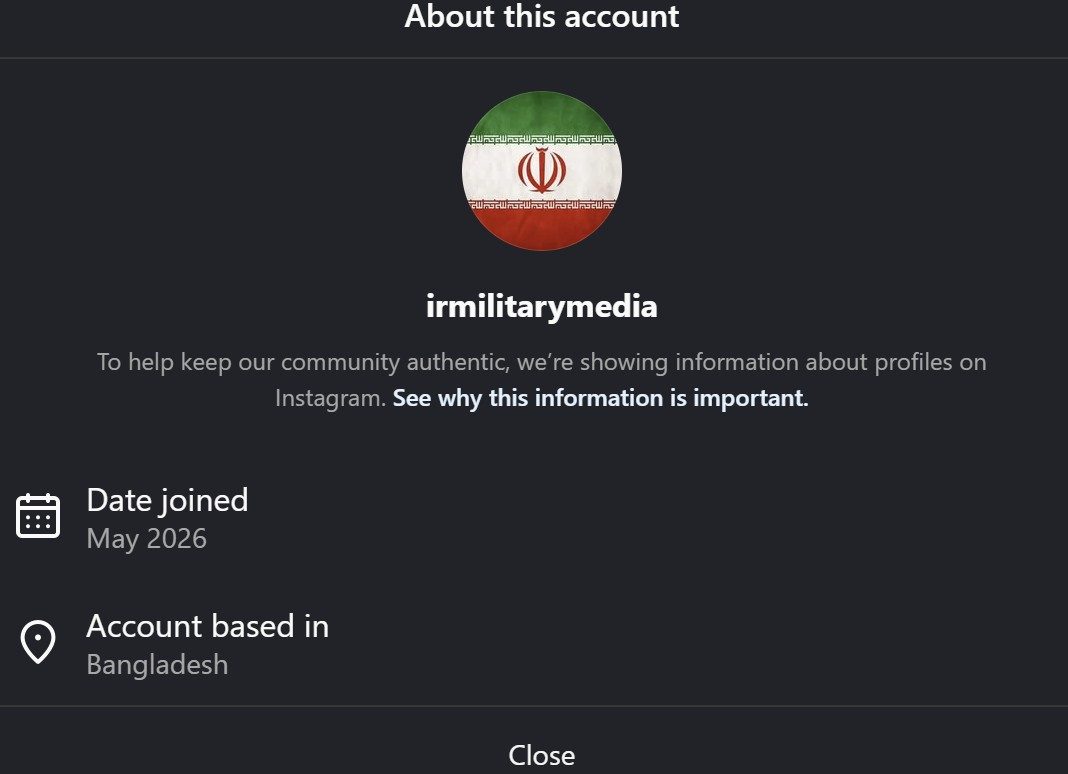 Exhibit C-3 · the small sibling @irmilitarymedia's inferred base is Bangladesh: a separate account-base signal, not a proven shared back end
A mid-2025 build-out, and a name that kept changing
Most of the current surfaces cluster in an eight-week window in mid-2025: the domain (15 Jul 2025), the Facebook page (19 Jun 2025) and the X account (Aug 2025). The Instagram account is the exception, it dates to July 2020 under earlier handles, so this reads as a repurposed legacy asset rebuilt into a mid-2025 cluster, not a single coordinated launch. Across that window the brand's name was rewritten repeatedly on top of a fixed emblem, the pattern of an asset being repurposed rather than a publication settling on its title.
The build-out, on the platforms' own timestamps
The Instagram account is the legacy asset (2020) and the Telegram channel followed in August 2024; the Facebook page, domain and X account then stood up together within eight weeks in mid-2025, in the same weeks the June 2025 Israeli and US strikes on Iran began, and the name was rewritten twice more. In other words, the cross-platform build-out accelerated during and immediately after the June 2025 strikes. Red marks the brand launches, blue the Instagram accounts, purple the website, gold the renames.
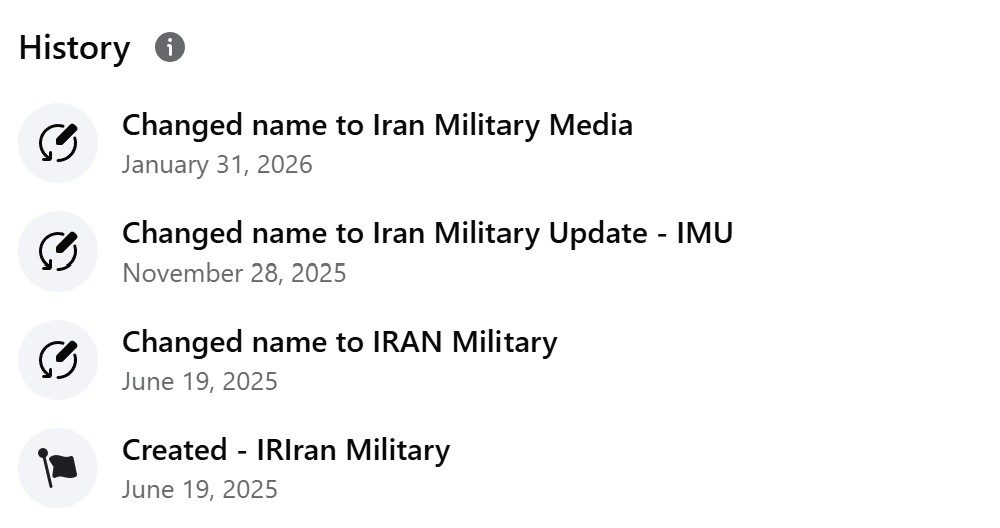 Exhibit C-4 · the Facebook page's name history: four names in seven months, one emblem throughout
And in their own words, when they are not selling "independent"
The contradiction is not only between the bio and the platform panels. It is between the bio and the operation's own description of itself. On its public storefronts, the brand says "independent." On its own website and in its own press-kit copy, it says the opposite, in plain language.
“Independent Media, Since 2009”Instagram bio, @iranmilitary.en
“Independent and Unofficial Media”Facebook page description
“non-state affiliated”the network's shared bio line, on X
“the official information portal of the Armed Forces”iranmilitary.info footer, live, verified 31 Aug 2026
“a respected semi-official press organ” with “privileged access to sources within the Iranian armed forces”the operation's own About / press-kit copy
“The Iranian army commits to maintaining professional standards and dedication to military truth”its own copy, written in the first person as the army
That second column is the operation's own promotional copy. It states that the brand has operated since 2009 as a
semi-official outlet, that it holds privileged access to sources within the Iranian armed forces,
that its exclusives include images of a US base in Qatar struck by Iranian missiles and confidential reports from
Syria, and that official Iranian media, it names the state news agency IRNA, the news agency Tasnim, a
defense-specialized agency and Iran's mission to the United Nations, treat its account as a reliable source. It
closes with a Tehran street address and the email contact@iranmilitary.info. I recovered this
particular copy on the dark web, from a Tor hidden-service archive; the provenance is laid out in full below.
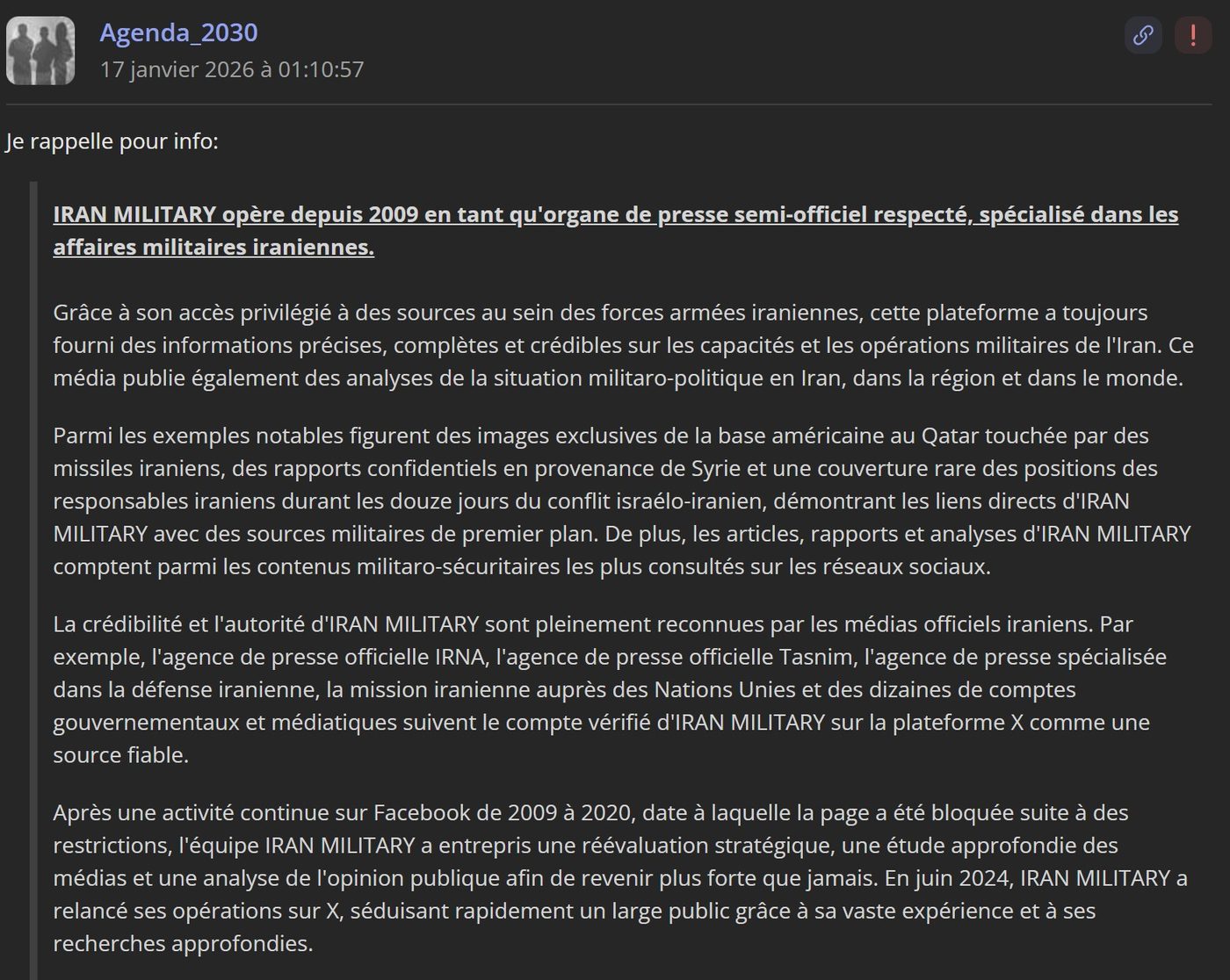 Exhibit F-1 · the operation's own press-kit copy (translated), recovered from a dark-web archive: a "semi-official press organ" with "privileged access to sources within the Iranian armed forces"
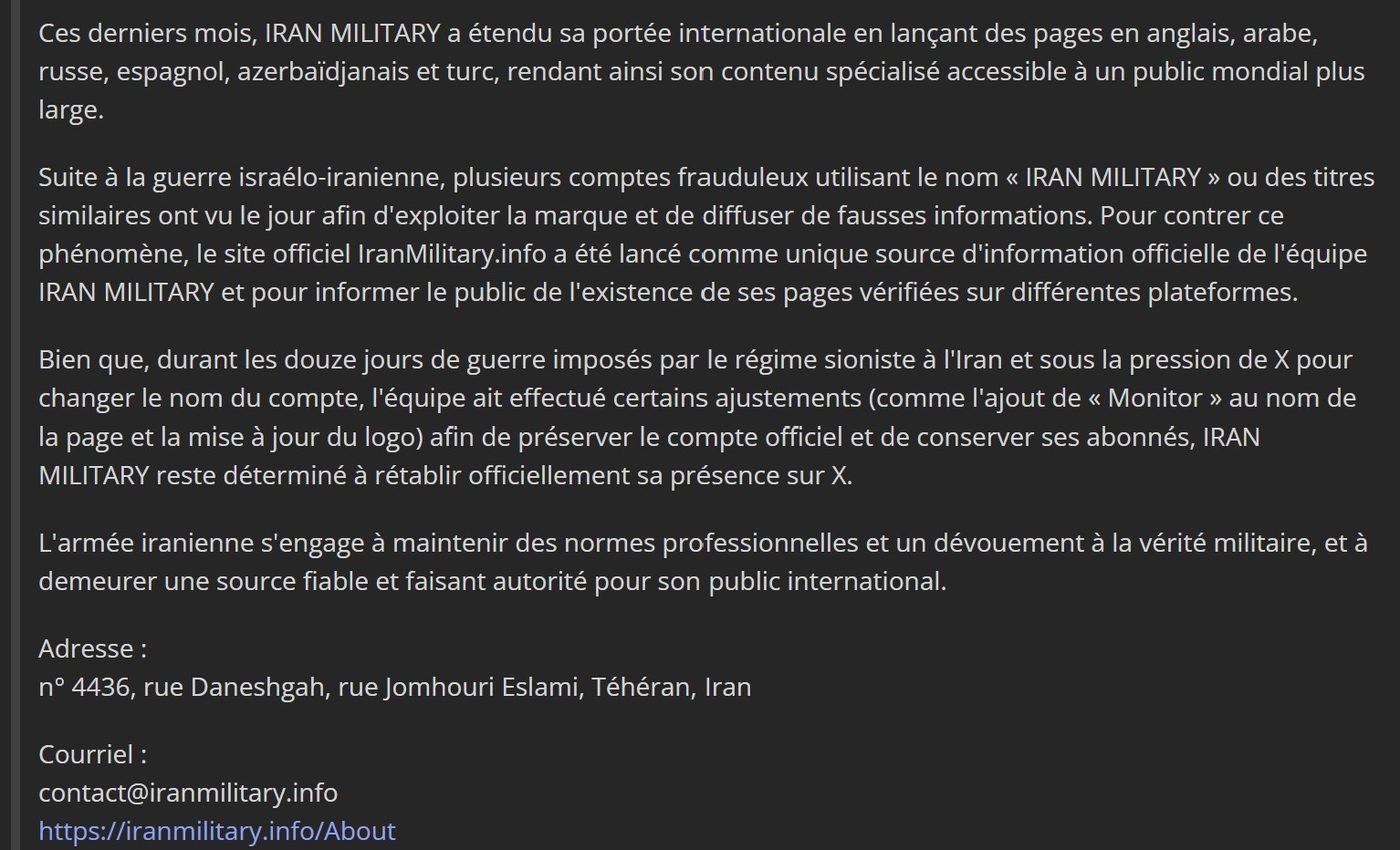 Exhibit F-2 · it speaks as the army ("The Iranian army commits to...") and lists a Tehran address and its own contact email
Provenance · where this text came from, exactly
I want to be precise about the chain, because it matters. The quoted copy is the operation's own
promotional "About" text: it is written in the first person about itself, it cites iranmilitary.info/About
as its source, and it carries the brand's own contact email and a Tehran address. Its self-identification is
corroborated independently by the live site's footer, which I read directly on 31 August 2026 and which
carries the same claim, "the official information portal of the Armed Forces."
Primary source: the cleanest copy is preserved on the Wayback Machine, which archived the operation's
own iranmilitary.info/About page on 28 February 2026, in English, in full. That live page has
since been removed, it now returns a 404, so the archive of their own site is what holds their own words. I
treat that Wayback capture as the primary source for the quotes above.
Independent second copy: the same boilerplate also surfaced on the dark web, a post on JvArchive,
a Tor hidden-service (.onion) archive of the public French forum jeuxvideo.com, where a French user had
reposted it to mock the brand for trolling a Western head of state (Exhibits F-1, F-2). The venue is a
dark-web archive; the text is the operators' own public press-kit copy, not something authored in the dark, so
I do not claim they run a hidden service. Unlike the operation's own page, this dark-web copy has not been taken
down, it was still live at the .onion address when I checked (I do not republish the raw hidden-service
URL here). Two independent captures of the same self-description, one from their own site, one still mirrored elsewhere;
I keep venue and authorship separate.
An operator's own self-description is a strong identity signal, and this one cuts directly against the "independent" label the brand sells to the public. I still hold one line: "semi-official" and "privileged access" are the operation's own claims, and an outlet has an incentive to inflate its proximity to power for credibility. So I do not convert the admission into a proven org chart. What is proven is the contradiction: the same operation that brands itself independent and non-state also describes itself, on its own site and in its own copy, as an official armed-forces portal with privileged military access. A reader should weigh the "independent" label accordingly (§09).
I tested the "official" claim, across all three platforms
Its credibility rests on being a recognized, semi-official outlet. The specific, checkable versions of that claim do not hold up.
The self-description makes specific, checkable claims: that it is a "verified account," and that Iran's official media, "IRNA, the country's official news agency, Tasnim News Agency, the Iranian UN mission office, and dozens of governmental and media accounts," follow it "as a reliable source." Those are falsifiable, so I tested them directly, on X, Instagram and Facebook.
aja.ir) and endorses none. That statement covers the Artesh specifically, not the IRGC or every armed component; and it is a self-interested denial that would read the same either way, so it rebuts the official claim, not state involvement.Read together, the "official" claim is not evidence of official status. It is a borrowed-authority technique: the operation inflates its standing to look credible to its audience, and the claim is false wherever it can be tested. Most deniable operations claim less than they are; this one claims more. I take no interested party's word for the truth here, not the operation's "semi-official," not the Army's "we disown them," only the checks I could verify independently.
And here is the part that matters: whether it is "official" is not the crux. What is established does not depend on that label, an Iran-based, Iran-aligned military-branded network, running at nearly 300 million view/play events across four platforms, with no visible label. Whether the hand behind it is a state channel, a paid contractor, or civilians who became a supplier, the pattern I documented with Explosive Media (§07), the observable behavior is the same. I do not go further than that. I also do not treat the absence of a smoking-gun tie as if it supported state direction, missing evidence lowers my confidence, it does not raise it. The final attribution is a determination for authorized investigators, not for open-source collection, and I leave it there (§09).
The brand overlaps with a 26-account coordinated network
Coordination proven for the core, converging on Iranian state accounts
The evidence so far establishes the brand's identity problem and its publishing behavior. The next question is whether it operates alone.
The military brand does not operate alone. It overlaps with a connected set of at least 26 accounts that present as independent Iran-focused media and show shared-operation signals. I mapped this network from a separate anchor (an account called "Iran News 24"), and it overlaps with the military brand here through shared follows and the same production tells. I grade coordination proven for the core (multiple independent signals, below) and probable for the outer clusters. The set converges on official Iranian state accounts, the Foreign Minister, the President, the Speaker, the Supreme Leader's office, while every bio in the core asserts it is non-state.
The network as an operational anatomy
Read it as a cross-section. At the center, the load-bearing core: the Iran News 24 accounts and the IRGC-branded persona set, where coordination is proven (mutual follows, a closed reshare loop, same-day creation pairs). Around it, the probable outer layers, a press-brand family, then the high-follower satellites and regime-persona accounts that form the visible surface. Ring color marks the layer; each face is a real profile picture, labeled with its handle; hover or tap any node to open the live account. Two accounts have been taken down or renamed since collection (shown as a red ✕). The per-layer evidence is summarized under the diagram.
Its own Facebook following list names the family
The clearest map of the network is the one the operation drew itself. The Facebook page follows a tight set of accounts, and it is not a random feed: it is a franchise. More than a dozen of the pages it follows are the same "Iran Military" brand in a different language, each carrying the identical circular Iran-flag emblem, just relabeled: English, Urdu, Turkish (İran Askeri Gücü), Spanish (Comandos iraníes), Arabic, Dari, French (Force Iranienne), Pashto, Hindi, Hausa (Sojojin Iran), Japanese, and Azeri. Around that core it follows Iranian state and state-aligned regional media (Press TV, IRNA, and the Lebanese pan-Arab outlet Al Mayadeen English) and the same production and amplification layer from my earlier reports, including Explosive Media, the LEGO-propaganda cluster. One franchise, Iran Hayom, publishes in Hebrew and mimics the name of the Israeli paper Israel Hayom; it appears designed for Hebrew-speaking or Israeli audiences.
Shared branding is not proof of shared control, but a dozen pages carrying one bespoke emblem, cross-followed from the main account, is strong evidence of a coordinated brand family, distinct from proof of common ownership. The map below is that following list, drawn from the operation's own page; each node links to the live page.
Who the Iran Military Media page follows on Facebook
Above the hub: the co-branded franchise family, most wearing the identical circular Iran-flag emblem, in a dozen-plus languages. Below the hub: connected accounts that are not co-branded, Iranian state media, the production and amplification layer, and other localized pages. Split this way, the shared-emblem cluster reads at a glance. This is the page's own Facebook "Following" list; each node shows that account's real profile logo and links to the live page. Captured 31 August 2026.
And Facebook lists Iran among the family's manager countries
Shared branding is one thing. Manager geography is another, and Facebook publishes it. Every page in this family above a certain size carries a "People who manage this Page" disclosure, and I opened it on each one, 17 in all. The result barely varies. Sixteen of the 17 list Iran among their manager countries, usually a team of several people, up to 10 on the Arabic page. Several also list one or two managers in Bangladesh or India, the same South Asian locations that appear on the network's X side, and one page, a low-follower backup account, lists that region alone (Bangladesh, no Iran). This is Facebook's own manager-country field, not my inference, and it is a location signal, not a statement of who owns or directs the pages.
| Page | Followers | Facebook: people who manage this Page |
|---|
Source: each page's own Facebook "Page transparency People who manage this Page" panel, read 31 August 2026. Pages below Facebook's size threshold (Plus Dot Plus, the Dari page, and other small franchises) do not display the panel and are omitted. For contrast, two state outlets the family follows resolve elsewhere: Press TV Highlights, which Facebook labels "Iran state-controlled media," shows Iran (3) and India (1); Al Mayadeen English, a genuinely Lebanese outlet the network amplifies rather than runs, shows Lebanon (9) and the United Kingdom (1).
I did not have to assemble this family myself. The main English page's own "About" section lists it, in the operation's words: "IranMilitary in French: Force Iranienne · in Spanish: Comandos iraníes · in Hausa: Sojojin Iran · in Pashto · in Dari · in Urdu · in Hindi · in Arabic · in Turkish: İran Askeri Gücü · in Azeri: İran komandoları · in Hebrew: Iran Hayom," then names its "Backup Account: Iran Military Media," its "Exclusive Iranian AI Media: Plus Dot Plus," its "Reliable News Source: IRAN Monitor," and, last, "Iran's Supreme Leader: Imam Mojtaba Khamenei." The network graph above is the operation's own self-listed family, read back to it.
Four accounts in this network display the name "IRGC." I do not label them the actual Islamic Revolutionary Guard Corps, and I want to be honest about why, because it is a deliberate evidentiary choice, not something I have disproven. I cannot prove these are official IRGC accounts, and I cannot prove they are not. What I can observe is that they wear the IRGC name and footage while their own bios disclaim official affiliation, and that nothing available to open-source collection, no platform verification, no official cross-link, no leaked administrative tie, establishes a government chain of control. An attribution to the actual IRGC would require proof I do not have, so I hold the finding at what the evidence supports: coordinated Iran-branded personas, one of them wearing IRGC branding. That is a floor, not a ceiling. It leaves open that a real state hand sits behind them; it simply is not proven from the outside, and I will not print an attribution I cannot stand up. I apply the same test to the brand's own "official" claim in §03, and the same discipline runs through the whole report (§09).
The same pattern on Instagram, from a list it keeps hidden
Facebook publishes who a page follows; Instagram does not, and @iranmilitary.en keeps its following
list hidden from the ordinary public interface. I collected it through a commercial social-intelligence
platform. It follows 64 accounts
in total, and most are a long tail of aligned individuals and fan pages. What matters is the core, and that
core mirrors the Facebook network almost exactly: the same military-brand siblings, the same LEGO and
AI-production layer, and the same state and state-aligned regional media it amplifies. It also follows one account SGI has
already reported on by name. That relevant core is below; the long tail is set aside to keep the picture clean.
Who @iranmilitary.en follows on Instagram — the network core
The network-relevant accounts among the 64 the Instagram account follows. Its following list is hidden from the ordinary public interface and was collected via a commercial social-intelligence platform (64 unique accounts after dedupe). Grouped by role, each showing its real profile picture; the blue tick marks a platform-verified account. The long tail of aligned individuals and fan pages is set aside; cluster labels are my classification. Ring color marks the cluster. Click any node to open the live profile. Captured 31 August 2026.
The blue-ringed node in the production layer above, @persiaboihemmat, is Mahdi Mohammad Hemmat, a US-based creator. I place him in the LEGO layer because he is, by his own on-camera admission, a LEGO-propaganda creator, but I ring him differently because he is an American, not part of the Iranian apparatus around him. In a separate SGI investigation, The "Bullseye Loomer" Threat: Who Made It, I identified him as the creator of the LEGO-styled "Bullseye Loomer" threat video, published in co-authorship with Explosive Media, the same Iran-based LEGO cluster from my Animal BOT Farm and AI-Iran LEGO reports and the collaborator panel that started this whole investigation (§07). So the Iran Military Media account here follows both co-authors of that content: Explosive Media and Hemmat. Their collaboration is proven; direct IRGC command over Hemmat is left open in that report, and I hold it open here too.
A defense-ministry-styled site, on a split infrastructure
iranmilitary.info: the layout, the "official statements," and where it is served from
The brand's website, iranmilitary.info, is where the "independent" framing is hardest to sustain. The Persian-language site is laid out like a defense-ministry portal. Its top navigation includes Official Statements (بیانیههای رسمی), Defense Achievements (دستاوردهای دفاعی) and Culture of Sacrifice and Martyrdom (فرهنگ ایثار و شهادت). The lead item on the day I collected quoted the acting Defense Minister, an IRGC brigadier general, and the page's art used Iranian national and defense iconography. I note the iconography as defense-ministry-style presentation; I did not confirm it as an official ministry seal or an ownership mark, and it appears within article art rather than as a site ownership badge.
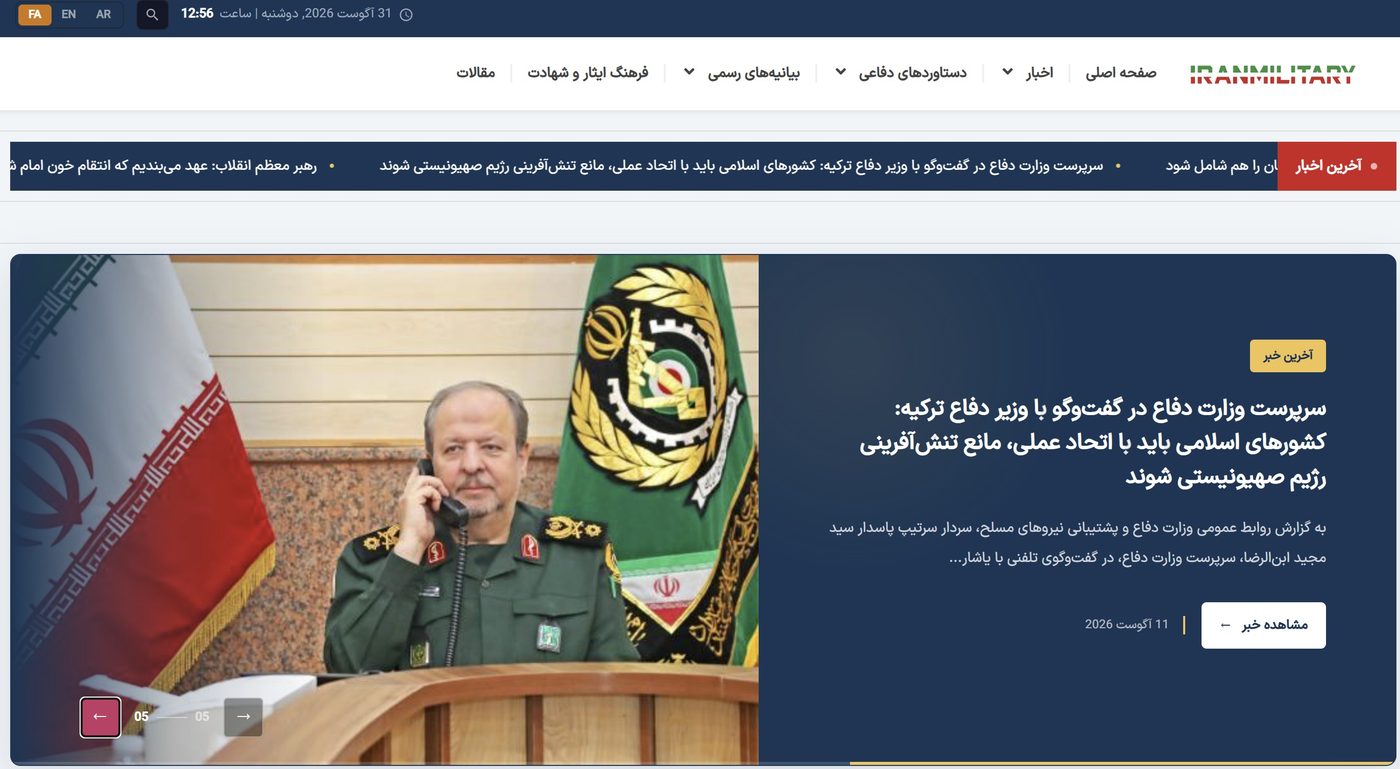 Exhibit D-1 · iranmilitary.info: a defense-ministry-styled portal with an "official statements" section, led by a quote from the acting Defense Minister
The site's Persian footer states its identity outright, "the official information portal of the Armed Forces"
(§03), the same brand whose English social profiles say "independent." The registration and hosting record is more
mixed than a single-country story, and I report it that way. The domain was created on 15 July 2025, in the same eight-week launch window as the X account
(August 2025) and the Facebook page (June 2025). Its authoritative nameserver hostnames use Mihan Web Host
branding (mihanwebhost.com, an Iranian provider), and its mail is self-hosted on the domain. The web server itself, though, resolves
to an IP operated by Hetzner in Germany, a mainstream European host. So the authoritative nameservers are
Iranian-branded while the web endpoint is served from Germany. I report the records and stop there: nameserver
branding is not proof of physical DNS-server location, and I do not attribute a motive (such as hiding an origin IP)
that the records do not establish. The registrant-country field reads Armenia, which can reflect privacy, a proxy or
a reseller as easily as a deliberate choice, so I treat it as a record, not as concealment.
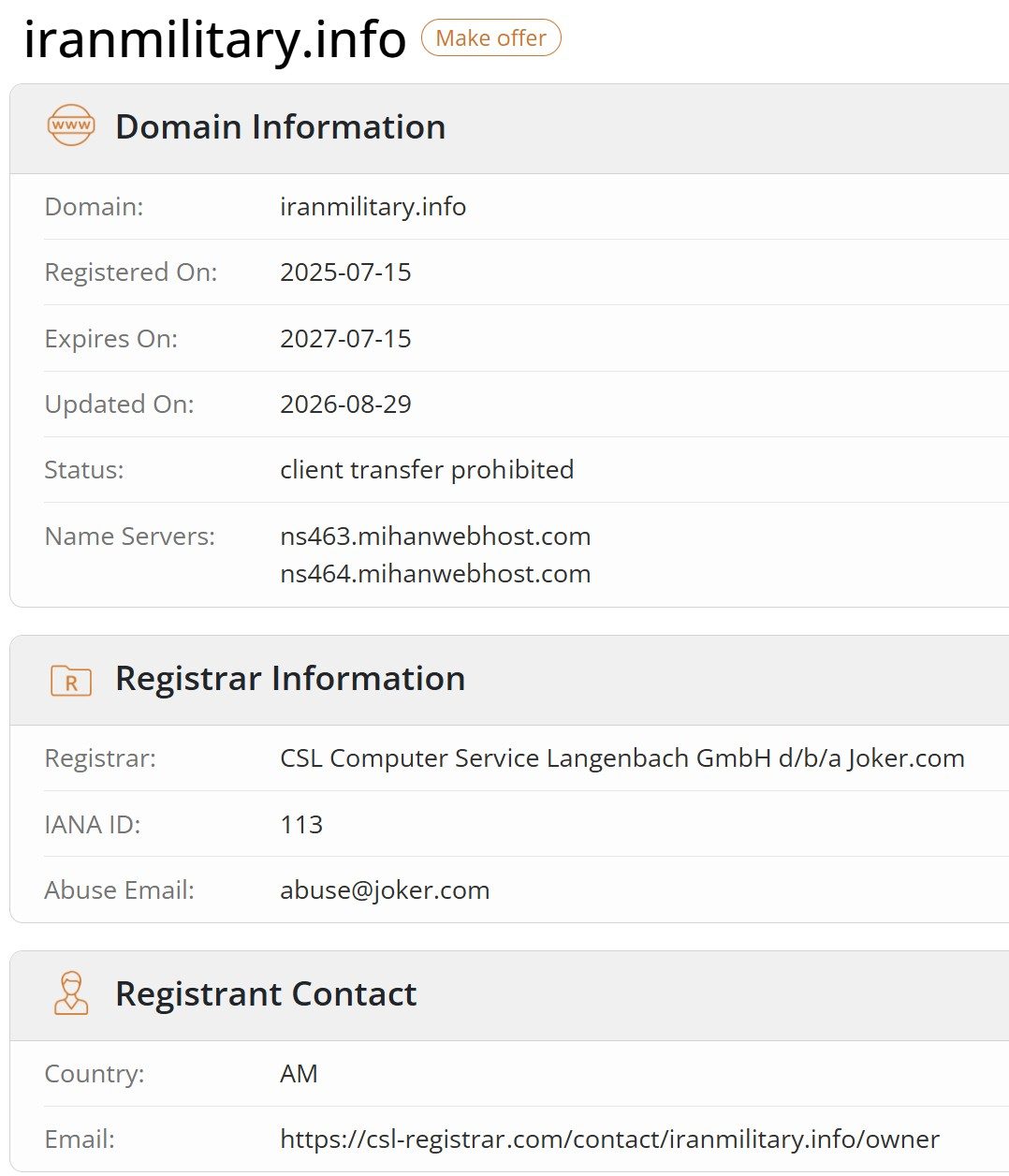 Exhibit D-2 · the domain record: registered July 2025, Iranian-branded nameservers, registrant-country field Armenia
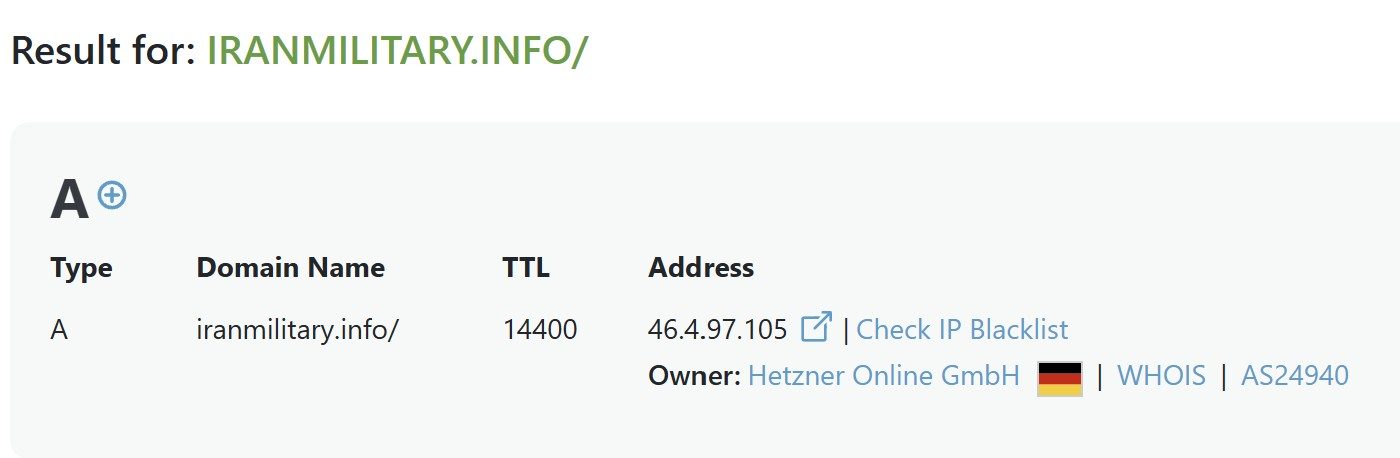 Exhibit D-3 · the web server: the A record resolves to Hetzner in Germany. Iranian DNS management, a German origin server
Method · what the hosting split does and does not prove
Nameserver strings and A records are reliable, passive tells for how a site is provisioned. Iranian-branded nameservers are consistent with an Iran-based operator and sit awkwardly with an "independent, run-from-nowhere" framing; the German web endpoint is the outward-facing half. Neither is, by itself, proof of state direction, or even of physical server geography: an enthusiast or a contractor could make the same choices. This belongs in the same column as the platform panels (§03) and the self-description above, one more observable consistent with an Iran-based operator, strongest in combination.
I did not find shared analytics or pixel IDs tying this domain to a named state property, and I report that as a negative rather than imply the check was inconclusive. Disciplined infrastructure that keeps those links clean is itself consistent with an advised or investigation-aware operator.
Two tracks: military relay, and a US culture-war wedge
Two content tracks on one feed: a regime military relay, and a higher-engagement US culture-war wedge
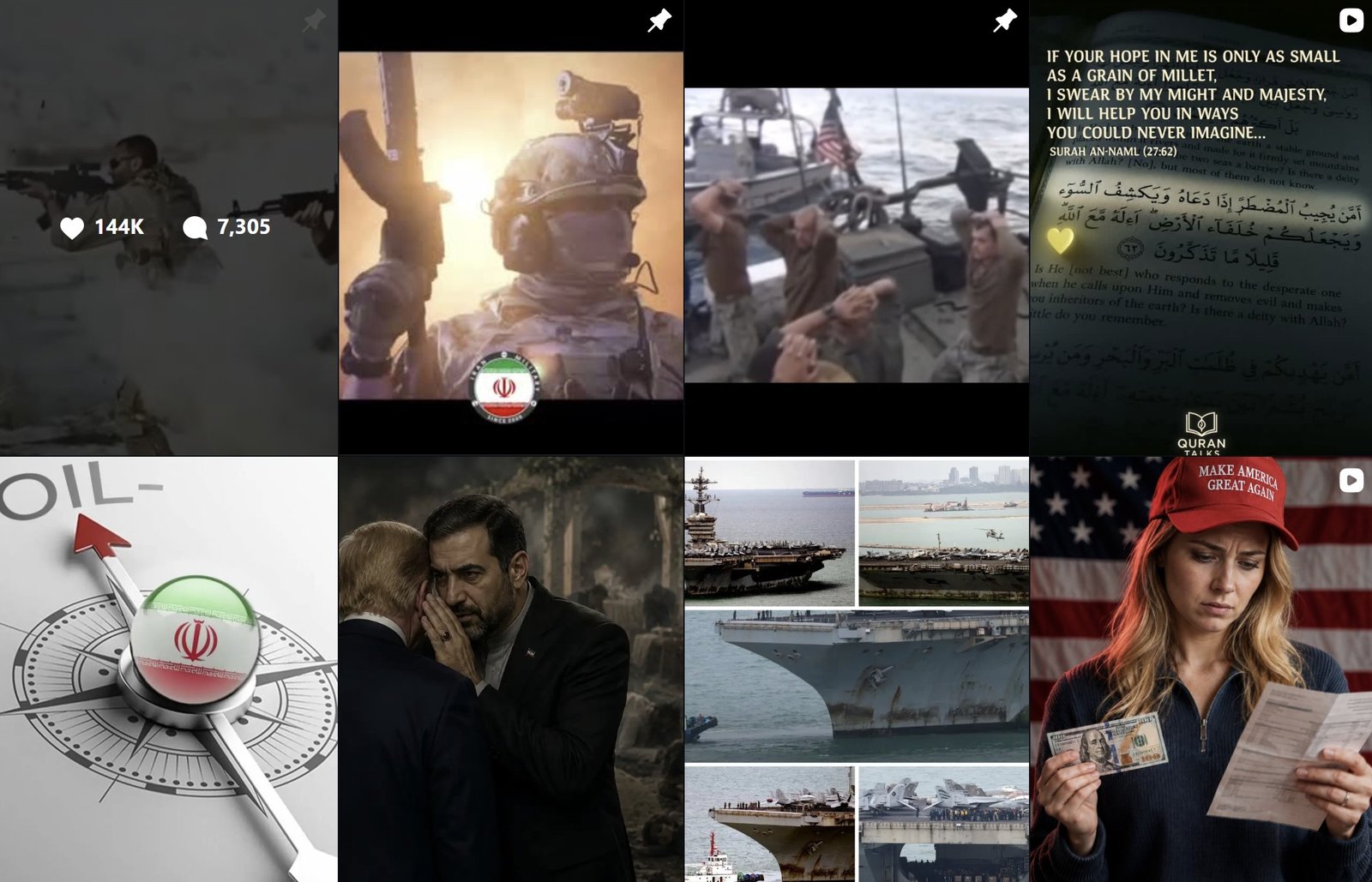
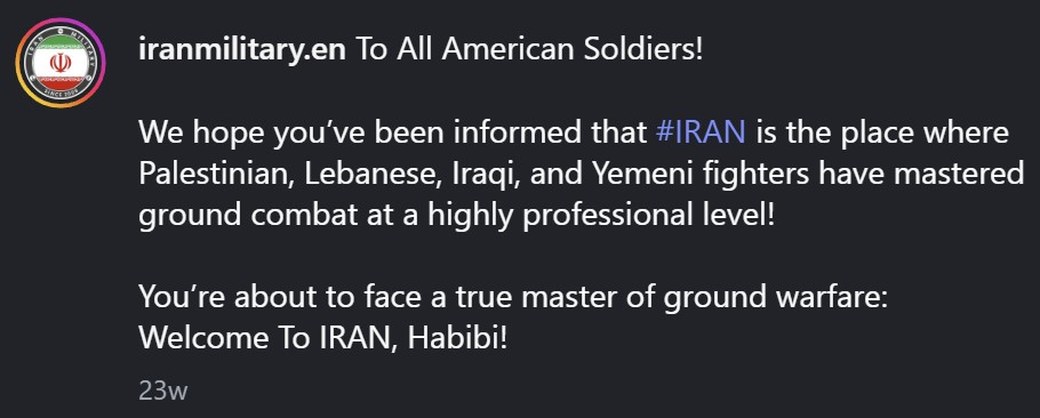
I ran language detection across the X account's full post history, all 844 posts (78% English-language), and keyword-coded them for topic; the topic read is a coding pass, not a fully adjudicated census, so I report it as a pattern. The feed runs on two tracks. One, the bulk by volume, is a straight relay of the Iranian armed forces: strike footage, commander quotes, threats of retaliation, close to half the posts read this way outright, and much of the rest is wordless clips carrying the same military footage. The other is US-domestic wedge content with no obvious connection to Iran: Trump, the Epstein files, conspiracy asides. The wedge is a smaller share of the posts but draws a far larger share of the engagement. The output is predominantly English-language and appears built for English-language consumption; I did not measure audience geography. Most posts came from a single desktop web client.
Track one · regime military relay
Track two · US culture-war wedge
Wedge posts drew a higher like rate on @IRanMediaco (coded sample)
In this coded sample from the network's anchor account @IRanMediaco, 38 US-domestic wedge posts showed a 5.14% aggregate like-to-impression ratio versus 0.90% across 94 military-relay posts (132 posts coded into these two categories; other/uncoded posts are not shown). @IRanMediaco is used here, rather than the flagship @IRMilitaryMedia, because it carries both tracks at volume. This is a descriptive association within the sample, not evidence that wedge content recruited, retained or caused audience growth, and results may be influenced by timing, format and outliers.
Some posts in the record make strong factual claims with no sourcing, and at least one runs a recurring inversion trope (that the crimes Iran is accused of are secretly committed by its adversaries). Within this report's scope I do not adjudicate whether those claims are true or false; I flag them as unsupported within the post and quote them so you can read them at source. I also do not attach a formal bias or antisemitism label: that requires each post mapped to a defined example set, a standard I hold rather than assert in passing. What is defensible now is narrower: an account whose platform panels point to Iran, branded around Iran's military, publishing unsupported factual claims to an English-language audience while calling itself independent news.
Where this fits in the Iranian influence landscape
The overt brand here, and the covert layers I have documented before
The collaborator panel at the top of this report, where I first found @iranmilitary.en, listed
alongside the Explosive Media LEGO cluster, is the first-party seam that connects this overt military brand to the
covert layers I had already mapped in earlier work. That single consented tie is not an outlier. The account runs its
own co-authorships at scale, and they resolve into two layers worth naming.
The panel was not a one-off: the full collaboration roster
Instagram's co-author feature is a two-way opt-in, a post lands on two grids only when both accounts accept, and
@iranmilitary.en runs its own. Across a sample of roughly 380 of its recent posts, 51 were
co-published with 40 different accounts. The roster below classifies 38 of those 40 into two layers; two co-authors are left uncategorized. One is an Iran-based production and media layer:
the LEGO studio Explosive Media, AI-animation shops, and outright state organs, the Arabic desk of Fars News
and the media center of the Islamic Development Organization. The other is a bench of verified,
English-language, mostly American personas, several of them self-described journalists, who repeatedly accept
co-authorship with an account Meta's own account-base data places in Iran, among them a legal advocate who lists former Reuters in
her bio (12 co-posts in the sample), and several US political-commentary accounts with six-figure followings. The number
on each face is how many co-authored posts it appears on in the sample.
Who co-authors @iranmilitary.en's posts
Each face here is a consented co-author tie only, an accepted Instagram collab, not evidence that the person is a witting agent, directed, or paid. Accounts that co-published posts with @iranmilitary.en, from a sample of ~380 recent posts (a fuller pull would find more). This figure shows the 38 of 40 observed co-authors that fall into the two classes below; two are uncategorized. Real profile pictures; blue tick = platform-verified; the ×N badge is co-authored posts in the sample. Red ring = Western / English-language co-authors; grey = Iran-based production, media and state accounts. Click any node to open the live profile. Captured 31 August 2026.
A co-authored post is a mutual, consented, observable tie: both accounts accepted it, and it is published to both. That is what I document here, and nothing more. I do not assert that any of these individuals is a witting agent, directed, or paid, that is not established, and a co-author invitation can be accepted with varying awareness of who sits on the other side. What is established is the pattern: an account Meta's own account-base data places in Iran, running military propaganda, systematically co-publishes with a roster of Western, verified, English-language personas. A co-author post is eligible to appear to both accounts' audiences; the actual reach per collaborator is not measured here. Where that crosses into witting participation is a question for authorized investigators, not for open-source collection.
Set beside the earlier work, a structure comes into view. Iran's overt state megaphone runs openly on X, from the Supreme Leader's 2.3-million-follower account down through the sanctioned state broadcaster, the Foreign Ministry and the IRGC-affiliated news agencies, none of them carrying a state-media label any longer. This brand and its network sit right among them, on the same platform, at comparable scale.
Where it sits on the X megaphone — by follower count only
Scale comparison only. Follower counts on X at collection. The Iran Military Media brand (red) and its network (gold) are shown beside Iran's official state accounts (amber) to convey relative size, being similar in follower count does not imply any affiliation between them. Focus each bar for the exact figure.
Beneath that overt tier sits the covert machinery I have mapped before: a million-account provisioning substrate on Instagram, LEGO-animation propaganda accounts, and networks that impersonate real people. This report is the overt-brand tier. The reports below are the layers under it.
Reach vs effect: what I can claim, and what I cannot
The scale is front-loaded at the top of this report; here is the discipline behind it
These relationships establish a distribution system. They do not establish how many distinct people it reached, or whether it changed anyone's beliefs.
The scale figures at the top of this report are real and countable, and this section keeps them honest by naming exactly what each counter is. Taken across the full reachable history of each account: on X, @IRMilitaryMedia's posts show 117.5 million views across all 844 of them (Mar–Aug 2026, the full reachable window), 78% English-language, with the single biggest post at 6.3 million, X's "views" counter includes repeat and self-views. On Instagram, @iranmilitary.en's videos show 64.2 million plays across all 1,130 of them, one reel 4.3 million on its own; Meta reel "plays" include replays, and image posts carry no public counter. On Facebook, the 579,000-follower page's 588 reels show about 63.7 million plays, again video only. On Telegram, the broadcast channel's 8,381 posts carry about 38.9 million views across its full history (Aug 2024 onward), a floor: post view counters were rounded down and roughly 1,600 posts returned no counter. Together that is about 284.3 million gross view/play events, nearly 300 million, plus roughly 8.76 million interactions (3.23 million on X, 5.53 million on Instagram). These are non-unique event counters, not counts of distinct people: excluded assets mean the recorded gross total is understated, while replays and cross-platform overlap mean the number of unique viewers is lower than the event total. The 284.3 million total includes public view counts across all 844 collected X posts, but it excludes Meta (Instagram and Facebook) image and text posts, which carry no comparable public play counter, and roughly 1,600 Telegram posts that returned no counter, so it is a floor.
Non-unique, and a floor. X views include repeat and self-views; Meta plays include replays; Telegram post views were rounded down and ~1,600 posts returned no counter; cross-platform overlap is unknown. All 844 X posts are counted; excludes Meta image and text posts (no comparable public play counter). Not a count of distinct people.
Keep four things apart. Followership is the summed follower/subscriber count, capacity, not viewers. Gross view/play events is the ~284M figure (a floor, nearly 300M), non-unique platform counters. Interactions is the 8.76M likes, shares and comments. Unique people reached, and whether any of it changed a belief or a behavior, is not measured here. Platform data shows distribution and effect are different quantities, so I report the distribution as distribution and stop there. The three population levels, kept apart:
The observable finding is not a belief-change figure I do not have. It is that a military-branded operation, whose flagship Meta assets list Iran among their manager/base locations while it calls itself independent, accumulated a measured ~284 million view/play events (a floor, nearly 300 million) across Facebook, Instagram, X and Telegram and remained publicly accessible at collection, carrying no visible state-media label. I do not infer non-enforcement from that: platform review, eligibility and policy status are not visible to an outside researcher, and TikTok's disposition is unknown. What I can say is that assets this openly attributable persisted at scale without a visible label, which is the point a platform-integrity or policy reader should weigh.
How the operation maps to Meta's kill chain
This uses one framework, Meta's Online Operations Kill Chain, the plain-English, observation-based sequence of phases (acquire assets, disguise them, gather an audience, deliver content, and so on) that Meta uses to structure its own threat reports. The behaviors here fill the early and middle phases cleanly. The last two rows sit beyond the kill chain, they are the lifecycle questions it does not cover: who is behind it (held as a hypothesis) and what effect it had (left unestablished, because I did not measure it).
| Kill-chain phase | Procedure | Observation | Basis | Confidence |
|---|
Codes are namespaced across two schemas: an observation-based kill chain for what the operation did, and a lifecycle model for where it sits. One observation carries one confidence tier however many rows it appears in. Empty phases are marked, not hidden.
Where the evidence stops, I stop
I hold the attribution where the evidence holds it. An Iran location signal is high confidence: it rests on the platforms' own location and management fields for Facebook and Instagram (X's inferred field reads West Asia), plus Iranian-branded nameservers on the website, plus defense-ministry-style iconography on its own surfaces. That is a location and self-presentation signal, not a finding about who employs or directs the operators. Coordination across the wider network is proven for the core on mutual follows, a closed reshare loop, same-day creation pairs and content recycling. And the operation's own self-description now sits on the record: on its live site and in its own copy it calls itself an official armed-forces portal with privileged military access (§05). That admission is a strong signal, and it cuts against the "independent" label, but I still stop short of one thing: I do not convert it into proven state direction. A self-claim of "semi-official" access is the operation's own assertion, and an outlet has reason to inflate its proximity to power; open-source evidence cannot reach whether an Iranian institution funds or tasks these accounts, which needs a platform backend or legal process. "Iran-linked on Meta's own manager-country and account-base fields (X reports an inferred West Asia; Telegram exposes no equivalent field), self-described as an official armed-forces outlet, while publicly branding as independent" is exactly as far as the evidence goes, and I stop there.
Other limits, stated plainly. I ran no authenticity pass on the follower bases and make no claim they are automated; the finding is the opacity and coordination of the source accounts, not the character of their audiences. The network map is drawn only where I observed edges, and a missing edge is not evidence of absence. The content read is a sample, not a census. And follower counts measure capacity; gross view/play events measure distribution; neither measures unique reach or effect (§08). None of these limits softens the core, which is unusually well-evidenced for open-source work: one brand, five surfaces, Meta's own manager-country and account-base panels placing its flagship assets in Iran, and a state-military identity it publishes under while denying it.
The core propositions, by confidence
A platform disclosure of the page's true administrators; shared analytics or ad-account IDs linking the website to a named state property; a wave of coordinated suspensions across the network; or per-post client data showing the same desk posting for multiple "independent" accounts. Any of those would move the attribution from structurally consistent with toward directly tied to. I will update if they surface.
How this was collected, and its limits
What this is and is not. I trace how a media operation is built and how it behaves; I do not adjudicate the truth of any claim it publishes, and I do not adjudicate the underlying conflict. Follower counts measure capacity; gross view/play events measure distribution; neither measures unique reach or effect (§08). The accounts that display the name "IRGC" in the wider network are personas adopting that branding, not official Iranian government accounts. I did not run an authenticity pass on any follower base and make no claim those audiences are automated. Sources are described only in general terms; I do not name the tools used to collect. The attribution is held where the evidence holds it (§09): Iran-linked at high confidence on Meta's own manager-country and account-base fields (X gives an inferred West Asia; Telegram exposes no equivalent public field), with state direction not claimed.
This report rests on open-source and commercially collected data: profile metadata and the platforms' own transparency and about-this-account panels, a domain registration record, public post histories, and follow-graph relationships. Some of it, notably the hidden Instagram following list, is not visible in the ordinary public interface and was retrieved through a commercial social-intelligence platform; other pieces come from commercial account-association tooling and public registration lookups. I do not name specific vendors; that is source protection, not a redaction of any finding, and it does not withhold the source class, dates or method. Screenshots are preserved with timestamps as exhibits.
The event count is incomplete, and unique reach is a separate, unknown quantity. Follower counts move; I cite them to the collection date. The ~284M total includes public view counts across all 844 X posts but excludes Meta image and text posts, which carry no comparable public play counter, and roughly 1,600 Telegram posts that returned no counter, so the true number of public events runs higher than shown. It is not a floor on unique people: repeats, self-views and cross-platform audience overlap can make the number of distinct people substantially lower, and unique reach cannot be inferred from this data. Follower counts measure capacity; gross view/play events measure distribution; neither measures unique reach or effect. I say so rather than let a big number imply a big impact.
Evidence-based assessment of publicly observable data, correlations and patterns. Certain claims remain unverified, and this is not a determination of wrongdoing. The accounts branded "IRGC" are treated here as personas adopting that branding rather than verified official government accounts; SGI does not assert, or disprove, an official-IRGC attribution. Analyst: T. Hawley, ShadowGraph Intelligence LLC.
The significance is not that 284 million people were persuaded. The evidence cannot show that. It is that a military-branded operation with contradictory identities built a multilingual publishing system, accumulated hundreds of millions of public counter events, and created repeated distribution opportunities in adjacent audiences through accepted collaborations. Who ultimately directed it remains unresolved. Its observable operating pattern does not.
I pull these threads in public. If you want to follow the work, or bring me one, I am @talk2trav on X and @talk2trav on Instagram, and SGI is at shadowgraphintel.com.
All reports